
Vitamin D and Tuberculosis
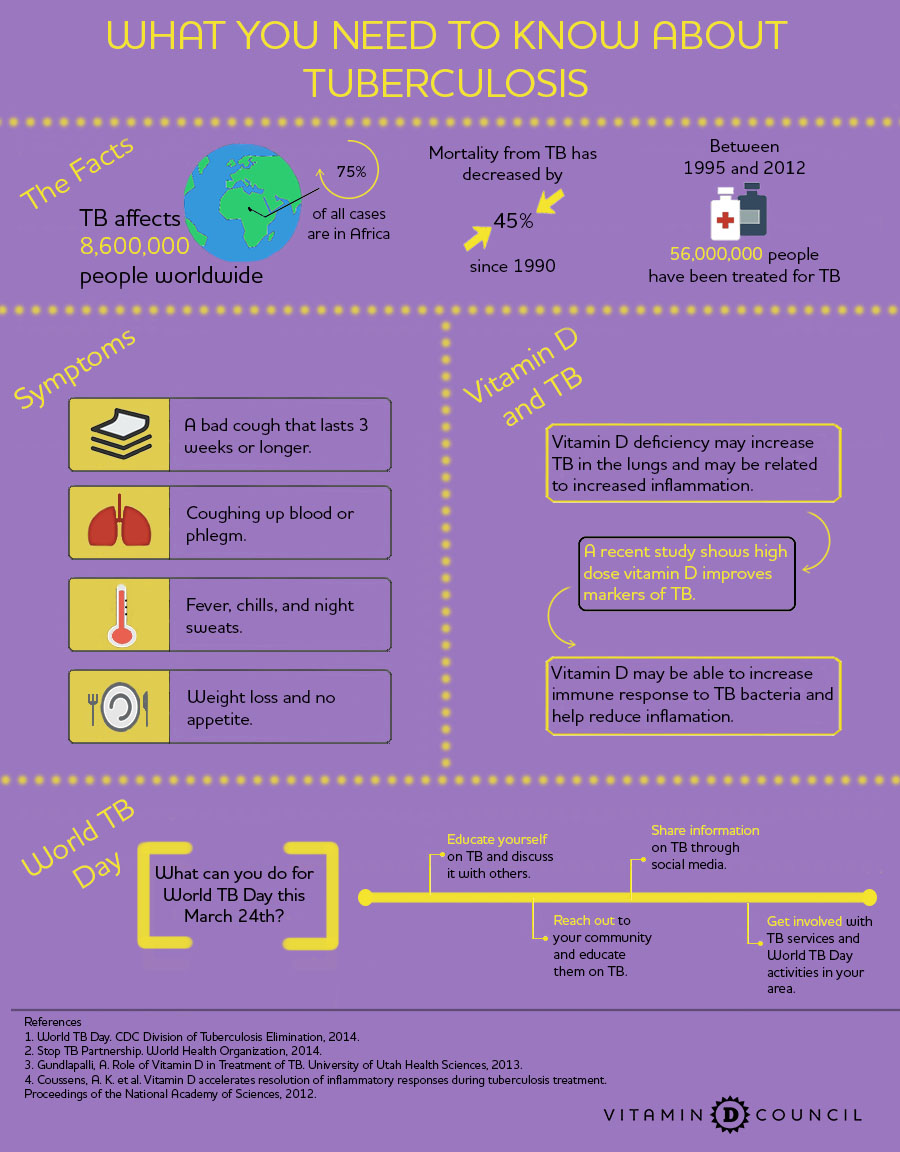
Today, March 24th, is World Tuberculosis Day. World Tuberculosis Day is a day to raise awareness about the infection and solutions to support worldwide control efforts of tuberculosis.
Tuberculosis (TB) is a bacterial infection. The bacteria, Mycobacterium tuberculosis, commonly attacks the lungs, but can also infect other parts of the body such as the kidneys and brain. TB can cause fevers, pain in the chest, weakness, and coughing up blood and phlegm. If not treated, TB can lead to death.
There are about 9 million people each year who are diagnosed with TB. Seventy-five percent of these cases occur in Africa. People with HIV or other health problems have a difficult time fighting infection and are more at risk for TB. TB can be spread when someone coughs or sneezes and others nearby breath in the bacteria.
Vitamin D and TB
Some research suggests that vitamin D supplementation may help some aspects of TB. In fact, in the early 1900s, cod liver oil and sunshine were used as treatment therapies for TB, suggesting a role for vitamin D in helping those with TB. Some newer research also suggests that vitamin D supplementation is helpful if you have TB in order to speed recovery.
Vitamin D can bind to immune cells and help these cells fight against and contain the TB bacteria. Researchers are also interested if vitamin D can help in improving lung function and breathing among those with TB.
People newly diagnosed with TB often have low vitamin D levels compared to people who don’t have TB. Thus, doctors and scientists think that low vitamin D might be a risk factor in contracting TB.
Learn More About the Best Vitamin D3 Available (click the bottle image above)
What can I do?
The World Health Organization and the International Union Against Tuberculosis and Lung Disease created the first World TB Day in 1982, one hundred years after Dr. Robert Koch discovered the bacteria that caused TB. World TB Day is a time to become aware and educate others on the prevalence of TB and how it can be stopped.
For 2014, the theme of World TB Day is “Reach the 3 million”. Of the 9 million people diagnosed each year with TB, around 3 million people don’t receive the health services they need.
Want to get involved and help reach the “missed” 3 million? Here are a few ways how:
- Fundraise. You can help contribute by fundraising and donating to the research and development of TB treatment therapies.
- Spread the word. Form a local World TB Day planning committee to come up with different strategies and activities using the Stop TB resource guide. You can also download and print Stop TB awareness posters to share in your local community.
- Attend an event. Find an event or activity in your community to join and help spread awareness on the need for access to TB treatment options. See a list of activities and events, here.
- Join a patient organization. If you have TB, you can join a patient organization to help be a powerful advocate for improved access to diagnosis and treatment of TB.
Source
People who read this page, went on to read the following pages:
Oldest Living People in the World
Coral Calcium – Goes Beyond Bone Healing
Sorting fact from fiction on vitamin D
by William Campbell Douglass II, M.D.
The clock is running out on 2011, but it looks like there’s still time to squeeze in one last phony vitamin panic.
In this one, researchers claim high levels of vitamin D will boost your risk of serious heart problems — despite what their own study REALLY found: that LOW levels of the sunshine vitamin will up your odds of heart failure, high blood pressure, kidney failure, and diabetes.
Of course, they didn’t want to talk about any of that.
Instead, the presentation at a recent American Heart Association meeting focused on the most freakish conclusion of the entire study: Patients with the highest blood levels of vitamin D — 100 ng/ml or higher — had a bump in the risk of atrial fibrillation.
Why is it freakish? Because I’ve been called an extremist for recommending blood levels of HALF that — 50 ng/ml — and even people who live in the tropics and get constant sun exposure all day long generally hover at around 60 ng/ml.
In other words, these just aren’t optimal or even realistic levels of vitamin D3 — and I’d bet that very few of the 132,000 participants in the new study actually fell into this category.
We don’t know for sure, because the researchers didn’t actually break it down for us.
We also don’t know how many patients fell into the next-highest category, between 80 and 100 ng/ml, but I’d bet this was the next-smallest group — yet these patients actually had the LOWEST A-fib risk of anyone in the study.
That means we’re supposed to believe that 100 ng/ml will prevent the condition — but 101 ng/ml will cause it.
PUH-leaze!
Ignore the panic and take your vitamin D3. Not only are “high” levels safe, but studies have repeatedly found that the sunshine vitamin will boost everything from your cardiovascular health to your immune system.
Winter is here, the sun is low — and you need your D now more than ever.
________________________________________________________
Just another example of the main stream supporting what Bob Barefoot has been teaching for over 30 years.
Just take your Vitamin D each and every day.
Different Types of Coral Calcium
Coral Calcium Types – An Explanation
It is important to recognize that two broad, but distinct types of coral calcium, are used as health giving supplements by the Japanese and many people throughout the world.
The first type is fossilized coral calcium that has been deposited on the land mass, or washed up on the beaches. The second type is taken directly from the sea bed. The sea-bed coral calcium is the coral that has dropped from the reef or is processed by reef inhabitants. This type of “coral sand” has been washed to the ocean floor by wave actions. Marine coral calcium is closer in composition to the living forms of corals, because the marine microbes are still active and many minerals and organic elements are retained, in comparison to fossilized, land-based coral.
These are important differences in composition between fossilized (land-based) and marine (sea-bed) coral calcium. Marine coral calcium contains more magnesium, and the balance of calcium (24%) to magnesium (12%) content of this second type of marine coral is close to 2:1. This 2 to 1 ratio is the ideal ratio for calcium and magnesium intake in the human diet.
My research has led me to believe strongly that the natural, magnesium enriched, marine coral calcium is to be strongly preferred as a health giving supplement over land based (fossilized coral), which contains less than 1% magnesium. This superiority of the marine coral is due to its retained, ideal, ionic balance of calcium and magnesium in a 2:1 ratio, and the fact that for the fossilized type, a host of other nutrients were also washed out during weathering processes.
Choose the best product available, Bob’s Best Coral Calcium 2000 which has a full of 2,000 mg per daily serving of Marine Coral Calcium.
Bob Barefoot
Chemist, Author, Lecturer on Coral Calcium and Vitamin D3 Supplementation.
Coral Calcium – Lifestyle and Minerals
Implicit in the desire for eternal youth is our wish to avoid poor health which seems to emerge with advancing age. Of all interventions that have been tried for enhancing well-being and long-life, few have worked. I believe that the issues are tied up in our lifestyle. The biblical patriarchs, who definitely had a different lifestyle, lived to be over 900 years old. Today, a healthy lifestyle is a key factor in extended life that must have a quality free from disease. Beyond the important, health sermons on cigarette smoking, stress, drug abuse etc., nutritional factors figure most strongly as determinants of health and well-being. The avoidance of all adverse lifestyle is advisable, but the domain of lifestyle most amenable to correction is “sound and appropriate nutrition.”
It is easy for a chemist (like myself) to see the body as a universe of interacting chemicals. Whilst this perception provides an incomplete picture of life, it is a good start to understanding the importance of minerals as a vital component of a diet for health, as each mineral must serve at least one specific biological function. With the exception of aluminum and silicon, the human body is made up of the same minerals, including gold, in differing amounts as the Earth. Mineral balance (especially calcium) in the body is an absolute prerequisite for health and longevity, but I trust this important advice will not be taken in isolation of instructions on a healthy lifestyle.
I recommend Coral Calcium and Vitamin D3 as a way to supply your body with the essential minerals and nutrients that we need for optimal health and longevity.
Bobs Best Coral Calcium 2000 and Bobs Best Vitamin D3 are the perfect solution. Just take one of each with every meal. You will experience a great benefit.
Bob Barefoot
Too much vitamin-D “can cause” damage to the kidneys?
Once again propaganda is emanating from the drug industry. The article in question claims that according to Wikipedia “too much vitamin-D “can cause” damage to the kidneys”. You will note that the article does not say that too much vitamin-D “does cause” but rather it says “can cause”.
The reason that it does not say that vitamin-D does cause kidney disease is that massive scientific studies, such as the Frock report on vitamin-D (done by hundreds of scientists and hundreds of doctors) have proven that even when taken in the millions of iu’s, vitamin-D3 does not cause damage to the body. Once again the article is misleading as it does not say that vitamin-D does cause damage but rather it tries to suggest that it does.
Most medical researchers today suggest that everyone take at least 15,000 iu of vitamin-D3 daily.
Bob Barefoot
Come get your supply of Bob’s Best Vitamin D today!