
Vitamin D and Tuberculosis
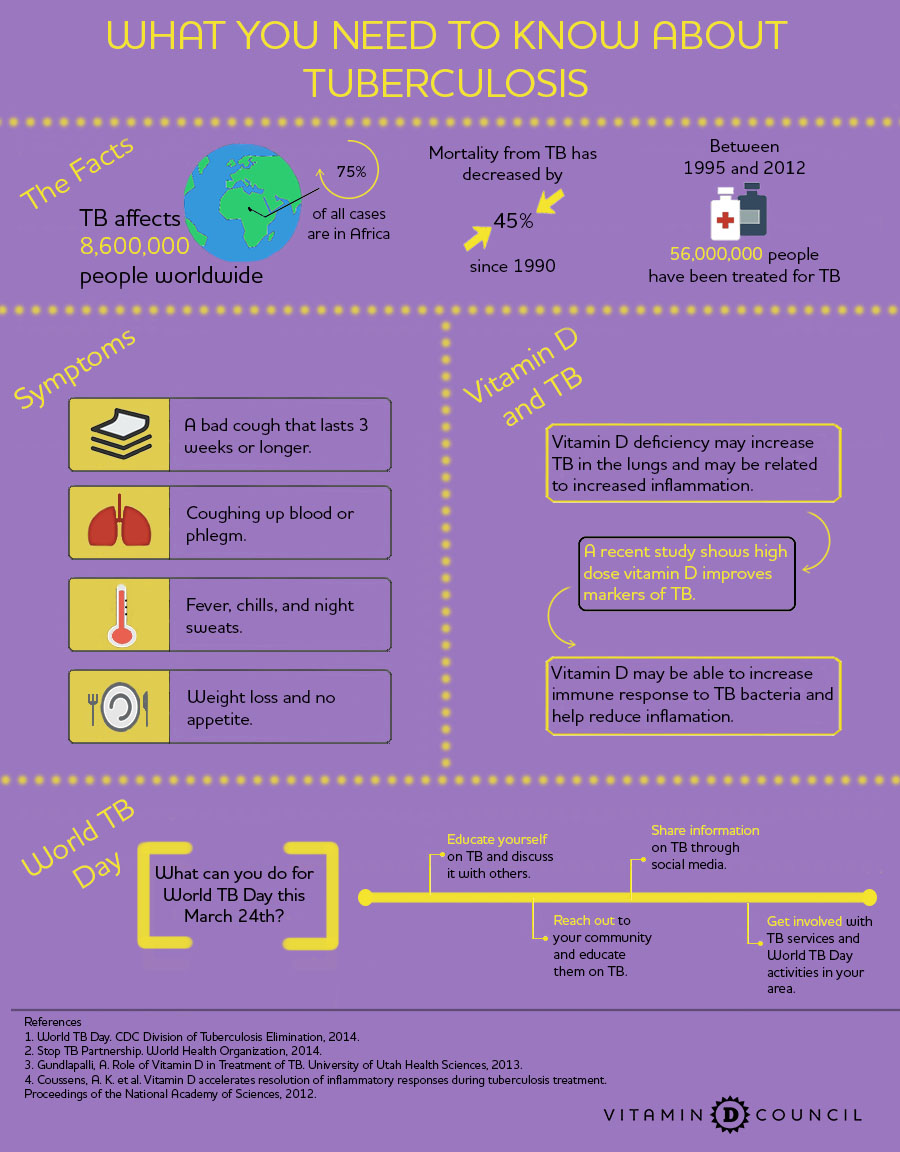
Today, March 24th, is World Tuberculosis Day. World Tuberculosis Day is a day to raise awareness about the infection and solutions to support worldwide control efforts of tuberculosis.
Tuberculosis (TB) is a bacterial infection. The bacteria, Mycobacterium tuberculosis, commonly attacks the lungs, but can also infect other parts of the body such as the kidneys and brain. TB can cause fevers, pain in the chest, weakness, and coughing up blood and phlegm. If not treated, TB can lead to death.
There are about 9 million people each year who are diagnosed with TB. Seventy-five percent of these cases occur in Africa. People with HIV or other health problems have a difficult time fighting infection and are more at risk for TB. TB can be spread when someone coughs or sneezes and others nearby breath in the bacteria.
Vitamin D and TB
Some research suggests that vitamin D supplementation may help some aspects of TB. In fact, in the early 1900s, cod liver oil and sunshine were used as treatment therapies for TB, suggesting a role for vitamin D in helping those with TB. Some newer research also suggests that vitamin D supplementation is helpful if you have TB in order to speed recovery.
Vitamin D can bind to immune cells and help these cells fight against and contain the TB bacteria. Researchers are also interested if vitamin D can help in improving lung function and breathing among those with TB.
People newly diagnosed with TB often have low vitamin D levels compared to people who don’t have TB. Thus, doctors and scientists think that low vitamin D might be a risk factor in contracting TB.
Learn More About the Best Vitamin D3 Available (click the bottle image above)
What can I do?
The World Health Organization and the International Union Against Tuberculosis and Lung Disease created the first World TB Day in 1982, one hundred years after Dr. Robert Koch discovered the bacteria that caused TB. World TB Day is a time to become aware and educate others on the prevalence of TB and how it can be stopped.
For 2014, the theme of World TB Day is “Reach the 3 million”. Of the 9 million people diagnosed each year with TB, around 3 million people don’t receive the health services they need.
Want to get involved and help reach the “missed” 3 million? Here are a few ways how:
- Fundraise. You can help contribute by fundraising and donating to the research and development of TB treatment therapies.
- Spread the word. Form a local World TB Day planning committee to come up with different strategies and activities using the Stop TB resource guide. You can also download and print Stop TB awareness posters to share in your local community.
- Attend an event. Find an event or activity in your community to join and help spread awareness on the need for access to TB treatment options. See a list of activities and events, here.
- Join a patient organization. If you have TB, you can join a patient organization to help be a powerful advocate for improved access to diagnosis and treatment of TB.
Source
People who read this page, went on to read the following pages:
Oldest Living People in the World
Hyaluronic Acid
Hyaluronic Acid – Nature’s Moisturizer

High Molecular Weight Hyaluronic Acid (HA) can be found in all joints, eyes and connective tissues where it lubricates the moveable parts of your body. The wear and tear of our body is maintained and resisted by Hyaluronic Acid, but as we age, our HA levels drop and as a result we begin to notice deterioration of our body.
High molecular weight, natural source and thickness are all crucial in the supplementation of our body’s declining reserves. As we age the viscosity of the joint fluid breaks down and becomes thin and unable to cushion the joint cartilage. This leads to increased friction and corrosion on the cartilage surfaces of the joints. Hyaluronic Acid helps to restore the normal viscosity of your joint fluid and to prevent further damage to your joints.
Although Hyaluronic Acid can be found naturally in all bone and connective tissues, it has the greatest concentration in the skin tissue. It is found in both the deep underlying dermal areas as well as the visible epidermal top layers. Young skin contains large amounts of HA which helps keep it smooth and elastic, but just as with bone and connective tissue, HA in the skin decreases with age. The body struggles to produce Hyaluronic Acid which leaves the skin unhealthy and wrinkled.
Each of our Hyaluronic Acid products yields the highest quality ingredients to restore Hyaluronic Acid deficiency throughout the body. To meet your specific needs we provide various forms of Hyaluronic Acid including pure, oral liquid, as well as skin serum and skin cream solutions. Improve your life today with effective, high quality Hyaluronic Acid!
View our extensive product line that can help you:
-Soothe and Moisturize Joints and Muscles
– Improve Skin Appearance
– Nourish and Rejuvenate
– Restore Mobility
– Safely Relieve Joint Pain
Sorting fact from fiction on vitamin D
by William Campbell Douglass II, M.D.
The clock is running out on 2011, but it looks like there’s still time to squeeze in one last phony vitamin panic.
In this one, researchers claim high levels of vitamin D will boost your risk of serious heart problems — despite what their own study REALLY found: that LOW levels of the sunshine vitamin will up your odds of heart failure, high blood pressure, kidney failure, and diabetes.
Of course, they didn’t want to talk about any of that.
Instead, the presentation at a recent American Heart Association meeting focused on the most freakish conclusion of the entire study: Patients with the highest blood levels of vitamin D — 100 ng/ml or higher — had a bump in the risk of atrial fibrillation.
Why is it freakish? Because I’ve been called an extremist for recommending blood levels of HALF that — 50 ng/ml — and even people who live in the tropics and get constant sun exposure all day long generally hover at around 60 ng/ml.
In other words, these just aren’t optimal or even realistic levels of vitamin D3 — and I’d bet that very few of the 132,000 participants in the new study actually fell into this category.
We don’t know for sure, because the researchers didn’t actually break it down for us.
We also don’t know how many patients fell into the next-highest category, between 80 and 100 ng/ml, but I’d bet this was the next-smallest group — yet these patients actually had the LOWEST A-fib risk of anyone in the study.
That means we’re supposed to believe that 100 ng/ml will prevent the condition — but 101 ng/ml will cause it.
PUH-leaze!
Ignore the panic and take your vitamin D3. Not only are “high” levels safe, but studies have repeatedly found that the sunshine vitamin will boost everything from your cardiovascular health to your immune system.
Winter is here, the sun is low — and you need your D now more than ever.
________________________________________________________
Just another example of the main stream supporting what Bob Barefoot has been teaching for over 30 years.
Just take your Vitamin D each and every day.
Reciprocal Harmony of Life in the Seas
The sea contains a massive expanse of life which it supports by its content of “free-floating” minerals and bio-active, nutritional compounds. Water provides an ideal communication pathway for messenger molecules of life. There are free floating hormones in some areas of the sea that are elaborated by certain marine organisms. These ecto-hormones (ecto means “from outside”) can be taken up by various other plants or life-forms in the ocean and cause many biological chain reactions that support the diverse array of marine inhabitants.
The chemical balance in the oceans supports life in complex ways. Therefore, one cannot be surprised by scientific reports that many marine life forms and their environmental waters or habitants, such as coral reefs, produce substances that have potent and versatile biological actions in nature. Marine compounds of various types have been found to be antifungal, antibiotic, anticancer, antiviral, growth inhibiting, analgesic, cardio-stimulatory (or inhibitory) and antangiogenic in their actions.
To add to our appreciation of the health secrets that the oceans contain is the recognition that four fifths of all life on our planet (about one half million species) lives in water. Massive amounts of suspended organic matter are incorporated into the food chain of marine organisms. Furthermore, marine organisms, such as living corals or mussels, process or expose their life cycle to thousands of tons of water. In one estimate, a small colony of mussels (ten million) can process one square mile of sea water that is 25’deep. As “big fish eats little fish” or marine organisms are used in complex food chains, the permutations of transfer of active molecules become limitless. Humankind joins this complex harmony of planetary life when it harvests the offerings of the oceans.
Coral Calcium is a true gift and benefits us greatly as a natural form of minerals and other natural components that we so desperately need to achieve optimal health. We are not destined for pain and discomfort as we age, we are just led to believe that this is normal. It’s not! Learn More…
Life in Water
Scientists may have tended to underestimate the importance of the oceans in sustaining life on our planet. The complex and varied composition of the oceans of the world make them home to more living organisms than the land. Water forms an ideal medium to contain all the inorganic material that are essential for the development and sustenance of life forms. The “vitality factors” contained within oceans, rivers, and land locked collections of water are the most important component of the food chain of all plant and animal life. The healing properties of sea water have been recognized by every culture for thousands of years. In some circumstances “treated sea water” has been used as medicine with variable benefit. In wartime, it was successfully used in lieu of blood for transfusions.
About 80% (four fifths) of the total animal life on the planet exists in the seas. Plant life is also abundant and seaweeds (especially kemp) are among the fastest growing most prolific plants on earth. The biomasses vary in density throughout the ocean. The deepest parts of the ocean supports life forms about which we know very little. The concept of “biomass” is important in oceanographic studies and it refers to the amount of living matter found per unit area of the sea. Underwater sea forests of kelp and coral reefs are rich biomasses that support a high concentration of living organisms. Coral reefs grow over thousands of years and mature into rich ecology where nutrients and elements are concentrated. If the oceans are considered a soup of life, the underwater forests, the coral reefs and the sea beds are the dumplings in the soup. These “dumplings” are huge “vitalistic” aggregations.
Whilst we are exploring the landmass of the earth, the oceans hold many secrets that are relatively inaccessible. This under- explored frontier of waters of the worlds surface has a volume of 42 million billion cubic ft or 286 million cubic miles. This calculates out to be 460,000,000,000 ounces of gold or over 100 times the gold held in the world’s vaults. Thus, the oceans are an enormous collection of metals, minerals, and chemical substances that sustain life. The seas contain many factors that are produced by its own living organisms.
An analysis of sea water shows variable results depending on the site of collection. However, it contains a striking array of organic compounds derived from plant and animal life. These compounds include organic acids, sterols, carotenoids, various free enzymes and variable amounts of macro and micronutrients (fats, carbohydrates, and proteins). Aggregations of life forms in the oceans, such as coral reefs, concentrate these complex compounds. It is easy to appreciate that the coral reefs are composed of, or exposed to, all nutrient classes known to man.
The sea rich in salt (sodium chloride) and every natural element known to man is present at one or other location. The contents of the sea are determined to a major degree by its residents, but oceans have many citizens who live in different geographical locations with distinct climates. Thus diverse ecology in the sea mirrors the diversity of life that is encountered on landmasses of the earth.
Author, Scientist, Lecturer
Bob Barefoot
For more information on the details of coral calcium and how it can assist you in attaining a healthy life see a listing of my books on Coral Calcium, Vitamin D and the benefits of mineral and vitamin supplementation.